
Life rarely slows down for us. We hurry from meetings to errands and are continuously checking notifications and ticking off endless lists to do. This constant state of “doing” puts our nervous system on high alert, and often we feel wired and tired. We crave rest, but when we are finally sitting down, our minds are still racing. This is where the silent magic of Yin Yoga goes into the picture.
Unlike the dynamic and sweaty flows of Vinyasa or Power Yoga, Yin is a practice of stillness and surrender. It asks us to cease trying and to just be. By holding poses for longer periods of time (usually three to five minutes) we are accessing the deeper connective tissues of the body (e.g. ligaments, joints, and fascia). But the physical release is only half the story. The real power of Yin is the ability to press the reset button on your mental state.
In this guide, we’ll discuss why it’s important to slow down and what you need to know about certain Yin Yoga poses to help you ground your energy and calm the mind. Whether you are an experienced practitioner or you are rolling your mat for the first time, these shapes provide a sanctuary of calm.
Why We Need to Reset the Science of Slowing Down
Most of our modern life exists in the “yang” sphere – active, hot, fast and productive. While yang energy is needed, an imbalance causes burnout, anxiety, as well as physical stiffness. Yin Yoga levels the playing field by activating the parasympathetic nervous system, or our “rest and digest” mode.
When you are in stillness in a pose, you are sending the message to your brain that you are safe. Your heart rate slows, your breath becomes deeper, and the levels of cortisol that are produced decrease. This physiological shift is what we refer to as a “reset.” It is not only about feeling nice for an hour; it is about training your body to go from stress to relaxation more efficiently.
Many students first make this great discovery while attending a retreat or going to a yoga school. They learn that the most difficult part of yoga is not the handstand, but sitting with oneself in silence.
Principles of Yin Yoga
Before delving into the poses, it is also helpful to know the three main principles, or “tattvas”, of Yin Yoga: Keeping these in mind will ensure that you are practicing in a safe and effective way.
1. Find Your Edge
Move into the pose to a point that you feel a strong sensation, but there is no pain. This is not on pushing to your maximal flexibility right away. Stop at the first point of resistance. This is your “edge.”
2. Remain Still
Once you locate your edge, take a vow of silence. Do not fidget or alter your clothes. Stillness in the body offers an invitation for stillness in the mind. The only exception is if you have sharp pain — in that case, ease out immediately.
3. Hold for Time
Yin poses are held for a series of minutes. This time is sufficient to enable the muscles to relax to transfer the stress out of them and into the connective tissues. If you are new at Yin, begin with 1-2 minute holds and work your way up.
5 Yin Yoga Poses to Ground Body and Mind
These examples of poses target common places where we tend to hold tension: the hips, spine and shoulders. You can practice them separately or you can sequence them together into one 30-minute complete reset session.
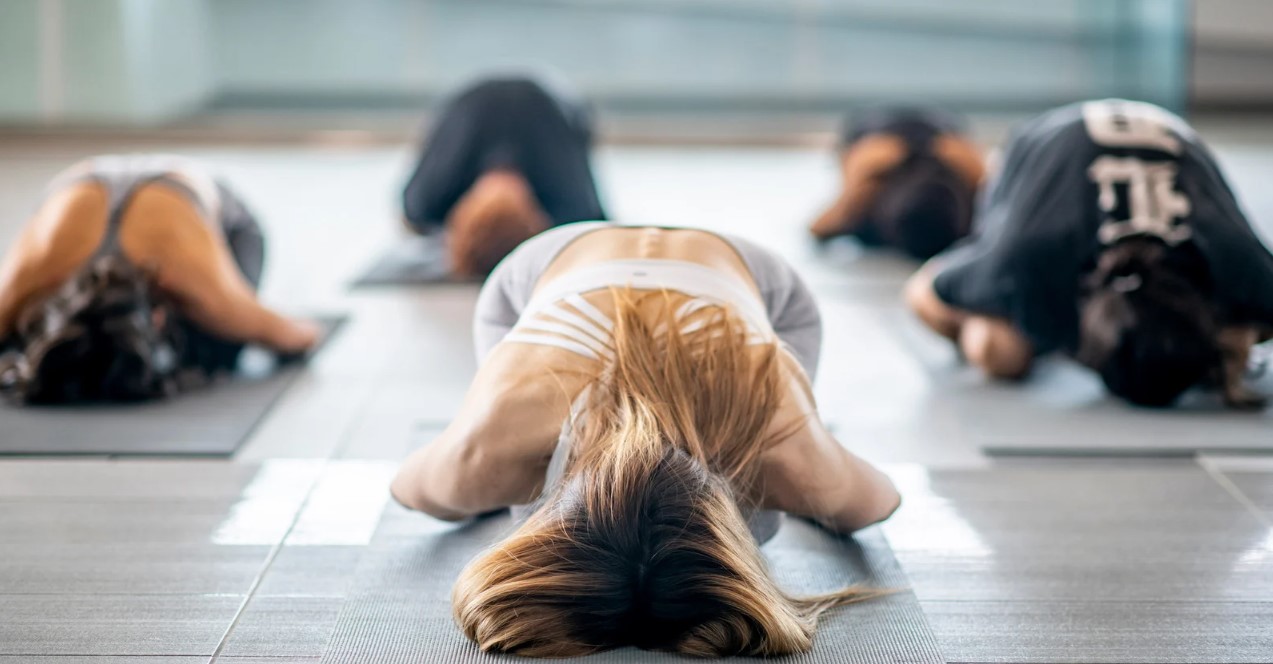
1. Child’s Pose (Balasana)
This is a trademark resting pose. It is good to stretch the hips, thighs, and ankles gently and relaxes the brain and helps to release stress and fatigue.
How to do it:
- Start on your hands and knees. Bring your big toes together and spread your knees apart (perhaps to the side of your mat).
- Sink your hips back to your heels.
- Walk your hands out and down to the floor and lower your forehead to the floor. If the floor seems a long way away, put a block or cushion under your forehead.
- Soften your shoulders off your ears. Let your arms be heavy.
- Hold: 3 to 5 minutes.
Benefits: This pose holds a gentle compression in the stomach and in the chest that can be very relaxing for the nervous system. It encourages you to focus your mind inwards, blocking out outside distractions.
2. Butterfly Pose (Baddha Konasana)
We tend to keep a lot of emotional tension in our hips. Butterfly pose works on the inside thighs and outside hips, releasing built up energy.
How to do it:
- You can also sit on the floor with your legs spread out. If your lower back rounds, use the edge of a folded blanket to sit on.
- Bend knee and place soles of feet together allowing knees to fall out to sides.
- Slide your feet back away from your groin so that you start in a diamond shape with your legs. This acts to the outer hips more than the inner groins.
- Inhale (while lengthening your spine) then exhale as you fold forward over your legs. Allow your spine to naturally round. Let your head hang heavy.
- Hold: 3 to 5 minutes.
Modification: If you are feeling your knees strained, put blocks or cushions under your thighs for support.
3. Sphinx pose (Salamba Bhujangasana)
Having folded forward, it is crucial to open the front of the body Sphinx pose gives a gentle compression to the lower back that stimulates the kidneys and adrenal glands which are often over taxed by stress.
How to do it:
- Lie on your belly with your legs out behind you hip-width apart.
- Put yourself on your forearms. Prevent your elbows from being directly beneath your shoulders, or move your arms forward for a lesser sensation.
- Relax your butt and legs totally. This is important here – if you squeeze your glutes you are using muscles that keep you from accessing the lumbar spine fascia.
- Let the head drop forward to relax the neck muscles in the back of the neck.
- Hold: 3 to 4 minutes.
Why it works: By compressing the lower back arch you rejuvenate the flow of energy along the spine. This can be incredibly refreshing after hunching over a desk for a day.
4. Caterpillar Pose (Paschimottanasana)
This forward fold stretches the entire back-line of the body from the heels, and up the legs and along the spine. It is very introspective and calming.
How to do it:
- Sit with legs straight extended in front of you. Keep the legs loose; let the feet flop open if they wish to.
- Fold forward over your legs from your hips. Allow your back to round.
- Put your hands on your legs or on the floor. Do not pull yourself further into the pose. Let gravity do the work.
- If your head is heavy, hold your forehead on a bolster or a pile of pillows on your legs.
- Hold: 4 to 5 minutes.
Insight: This pose resembles the fetal position and gives a feeling of safety and protection. It acts as a powerful contrary content to the stimulation of daily life.
5. Corpse Pose (Savasana) or Pentacle
Every yoga practice should be followed by integration. In Yin, we often use “Pentacle” pose as a sort of Savasana, but wide legged and wide armed, allowing the energy (qi or prana) to settle.
How to do it:
- Lie flat on your back.
- Take your feet wider than hips and let your arms rest far off your body and palms facing up You should be looking like a starfish.
- Close your eyes and let go of your breath.
- Hold: 5 to 10 minutes.
Focus on the sensations in your body. You may feel some tingling, warmth or a sense of fluidity. This is the “rebound,” where the magic of the practice sinks into your tissues.
Taking Your Practice Deeper
While it is invaluable to have a home practice, being immersed in an environment that is devoted to learning can be life-changing if you want to change your grasp of yoga. Sometimes, we need to physically take ourselves away from our daily triggers in order to truly reset.
Imagine doing these poses amidst lush tropical greenery, and with the sound of nature instead of honking traffic. This is why many students decide to gain a deeper knowledge with a Yoga Teacher Training course in Bali. The Island of the Gods offers a unique spiritual energy that complements the introspective nature of the Yin Yoga perfectly. Whether you aim to teach or simply want to better understand your own body, the idea of dedicated study within such an environment can be a life changing experience.
Conclusions: Make Resetting Habit
You needn’t be on the floor for an entire hour to reap benefits of the Yin Yoga. Even spending ten minutes in Child’s Pose or Butterfly Pose before bed can lead to a significant improvement in the quality of your sleep and your mental state.
The goal isn’t to be the most flexible person in the room. The idea is to develop a relationship with your body that is one of listening rather than demanding. By getting in this pose regularly (hitting the reset button), you are building a reservoir of calm that will stay with you long after you roll up your mat.
Start small. Pick one of these poses and try it out tonight. Your nervous system will thank you for doing so.
You Might Also Like